


The four latest Claude models: which one should you pick?
Fable 5.2, Opus 5.5, Sonnet 5.5 and Haiku 5.5 explained: what each model does, when to use it, and which plan includes it.
No single model fits every task. Match the model to the task and you save time and cost.
Claude Fable 5.2: for the hardest tasks
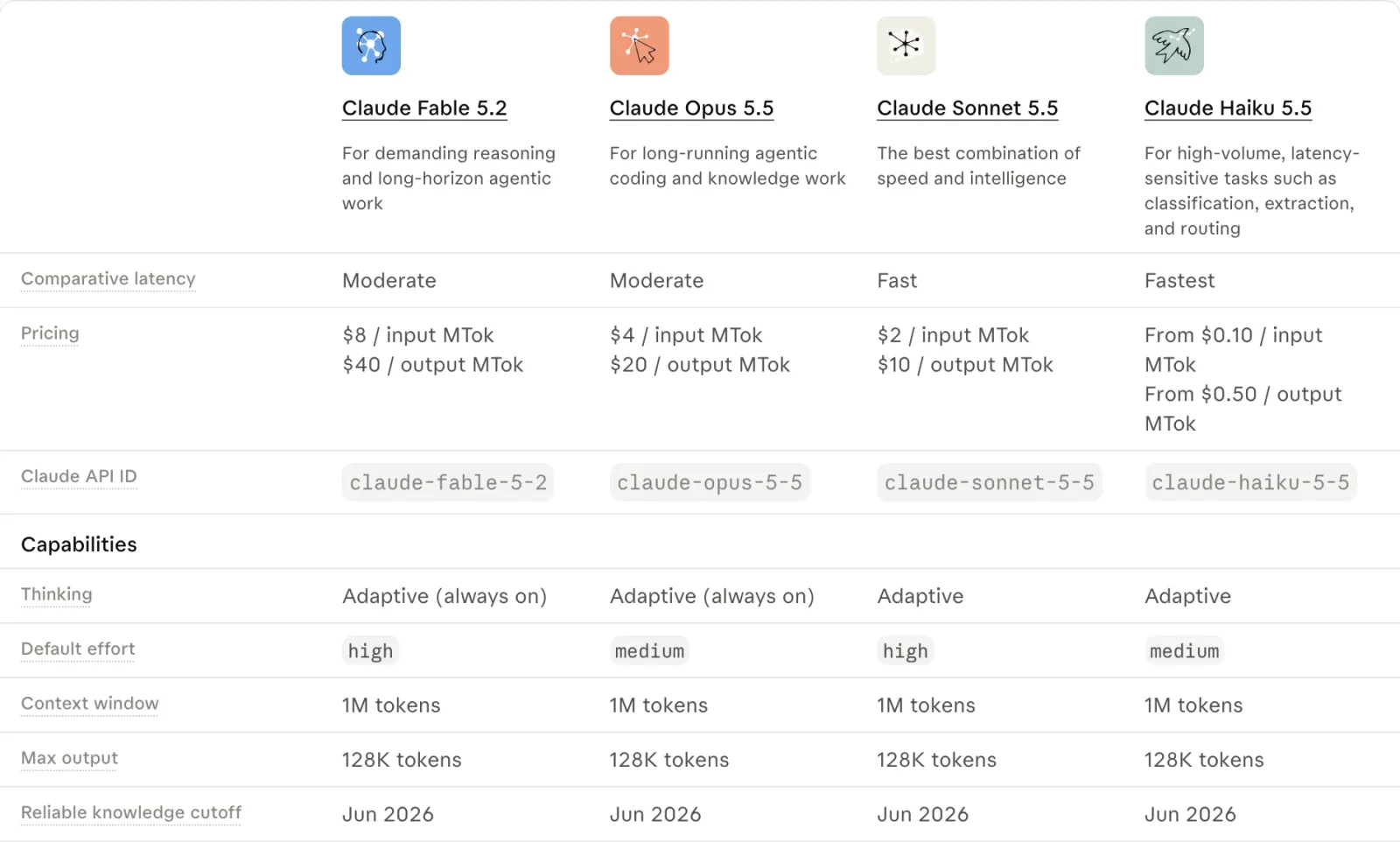
Anthropic released this model on 9 November 2026, and it is the most capable of the four. It is built for demanding reasoning and long-horizon agentic work. It is slower and more expensive than the others, so save it for exceptional tasks.
- Thinking is always on: the model decides how much thinking a task needs, and you cannot turn it off.
- Long tasks: agent sessions that run for hours, multistep deep research, and analysis carried through to a finished document, spreadsheet or deck.
- Availability: not in Free. Uses usage credits on Pro, included on Max and Ultra up to 50% of the weekly limits, available on Team for premium seats only, and included on Enterprise.
- API price: $8 per million input tokens and $40 per million output tokens.
Its twin, Claude Mythos 5.2, has the same capabilities and is only for organizations Anthropic has verified, so regular users will not see it.
When to use it: when Claude Opus 5.5 is not enough to solve a hard problem, when you need an agent that works on its own for a long time, or when you want a complete report or analysis from raw data in one go.
Claude Opus 5.5: the starting point for heavy work
Released on 22 September 2026 for long-running agentic coding and knowledge work. If you are unsure which model to use, Anthropic recommends starting with this one for most workloads.
- Long coding work: coding agents that run on their own for hours, and large-scale refactoring.
- Complex systems: designing and engineering complex systems.
- Images and computer use: vision-heavy work, and controlling a computer on your behalf (computer use).
- Availability and price: not in Free; included in Pro, Max, Ultra, Team and Enterprise. API price is $4 per million input tokens and $20 per million output tokens.
When to use it: for designing and engineering complex systems, in-depth research and analysis, and running agents that must stay consistent through a long task.
Claude Sonnet 5.5: the balanced workhorse
Released on 28 September 2026. Anthropic describes it as the best combination of speed and intelligence. It is built for everyday coding, running agents and regular business work.
- Everyday writing and content: creating, summarizing and editing content.
- Code and data: code generation and data analysis.
- Images and tools: understanding images and using tools inside agent work.
- Availability and price: in Free and every paid plan. API price is $2 per million input tokens and $10 per million output tokens.
When to use it: for most of your daily work, from content to code, and for high-volume tasks where the balance between speed and cost matters.
Claude Haiku 5.5: the fastest and cheapest
Released on 7 October 2026, it is the fastest and least expensive of the four. It is built for high-volume tasks that need a quick response.
- Speed: the fastest of the four models.
- Repetitive tasks: classification, routing requests, and extracting data from text.
- Helper for agents: handles small subtasks inside larger agent work.
- Availability and price: in Free and every paid plan. API price starts at $0.10 per million input tokens and $0.50 per million output tokens for prompts up to 100,000 tokens. Above that, it is $0.50 for input and $2.50 for output per million tokens.
When to use it: for light agents that run repetitive tasks, for classification, extraction and summarizing at scale, and for quick replies.
Which plan includes which model?
All four models can read up to 1 million tokens at once in their context window (about 555,000 English words).
Sonnet 5.5 and Haiku 5.5 only.
$20 a month, or $17 a month billed annually. Adds Opus 5.5, and Fable 5.2 runs on usage credits.
Max is $100 and Ultra is $200 a month. Both include all four models, with Fable 5.2 usable up to 50% of the weekly limits.
Includes Opus 5.5, Sonnet 5.5 and Haiku 5.5. Fable 5.2 is available on premium seats only.
Includes all four models.
Prices and usage limits change often, so check claude.com/pricing before you subscribe.
For everyday tasks, choose Claude Sonnet 5.5. It gives the best balance of speed and intelligence, and it is in Free. Move to Opus 5.5 when you need deeper thinking, and save Fable 5.2 for the hardest tasks. For simple repetitive work, use Haiku 5.5 to keep costs down.
Quick map for choosing
Speed and savings: simple, repetitive, cost-sensitive tasks.
Your daily work: the best balance, and your default for most tasks.
Deep thinking: systems engineering, complex research and analysis, and long jobs.
Most capable: for the hardest tasks and for agents that work on their own for a long time.
Sources: Anthropic models overview (platform.claude.com/docs), the model pages for Claude Fable 5.2, Opus 5.5, Sonnet 5.5 and Haiku 5.5, and the plans page claude.com/pricing. Checked November 2026.
Want your team to use this at work?
I'm Abdulaziz Alshamsi, a certified AI trainer and consultant in Abu Dhabi. I train government and company teams to use AI in their daily work. Message me to discuss a session for your team.