
OpenAI announced Deployment Simulation yesterday, a new methodology for predicting how AI models will behave in production before they are released. The approach replays real user conversations through candidate models to catch behavioral drift, addressing what the International AI Safety Report 2026 identified as a critical "evaluation gap" between pre-deployment testing and real-world performance.
The Problem: Models Change After Release
Anyone who has deployed AI systems at scale knows this challenge. A model performs well on benchmarks, passes internal testing, and then behaves differently in production. Sometimes the differences are subtle. Sometimes they are not.
A PLOS One paper published in February 2026 ran a ten-week longitudinal evaluation of deployed transformer services and confirmed what many practitioners suspected: "meaningful behavioral drift" that was real, measurable, and had no public explanation. Providers do not release update logs or training details, making it difficult to understand why model behavior shifts over time.
This drift creates real problems. Enterprise customers building applications on top of these models need consistency. Regulators need assurance that models behave as evaluated. Users need predictability.
How Deployment Simulation Works
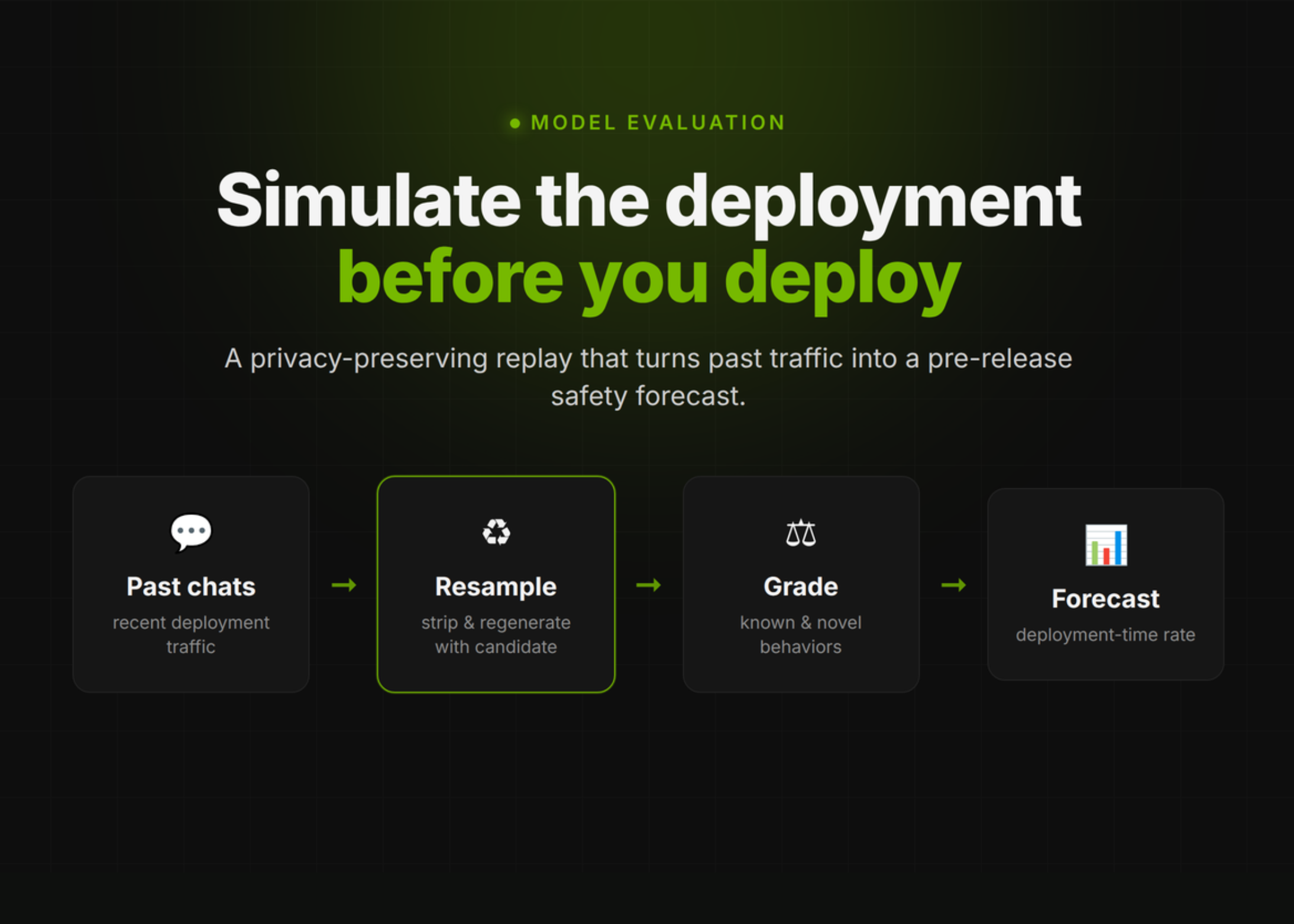
OpenAI's approach is conceptually straightforward but technically sophisticated. The system takes recent, privacy-preserving conversation logs from production, strips out the original assistant responses, and feeds the same prompts to the candidate model slated for release.
The key insight is that models can recognize synthetic test scenarios but struggle to distinguish simulated production traffic from actual deployment. By using real conversations (with appropriate privacy protections), the simulation creates conditions much closer to actual use than traditional benchmarks.
For agentic AI systems that autonomously call tools and APIs, Deployment Simulation extends beyond conversation analysis. It uses simulated tool execution to test how candidate models handle real-world tool interactions without actually calling external systems.
Validation at Scale
OpenAI validated this methodology across approximately 1.3 million de-identified conversations spanning GPT-5 Thinking through GPT-5.4, covering August 2025 to March 2026. They pre-registered predictions for 20 types of undesirable behavior on GPT-5.4 Thinking before deployment, then measured how well simulation predicted reality.
The evaluation examined three dimensions:
- Taxonomy coverage: Did post-release auditing find important behaviors the simulation missed?
- Directional accuracy: Did simulation correctly predict whether behaviors would increase or decrease in frequency?
- Rate calibration: Were estimated rates close to what actually appeared after release?
The aggregate result was a median multiplicative error of 1.5x. For context, if the true rate of a specific misbehavior is 10 per 100,000 messages, the simulation would estimate roughly 15 or 6.67. That is close enough to inform deployment decisions, though tail errors can reach approximately 10x in outlier cases.
Practical Implications for AI Deployment
This development has several implications for practitioners and organizations deploying AI systems.
Enterprise confidence improves. Organizations building on OpenAI's models gain additional assurance that behavioral changes are being caught before release. This matters for compliance-sensitive industries where unexpected model behavior creates regulatory exposure.
The evaluation gap narrows. Traditional benchmarks test specific capabilities in controlled conditions. Deployment Simulation bridges the gap to real-world behavior by using actual usage patterns. This is particularly important for agentic systems where tool interactions create complex behavioral possibilities.
Transparency expectations rise. OpenAI publishing this methodology creates pressure across the industry. Customers and regulators will increasingly ask other AI providers how they validate model behavior before deployment. "We run benchmarks" may no longer be a sufficient answer.
What This Means for the Region
For AI practitioners in the UAE and Middle East, this development reinforces a broader trend: mature AI deployment requires robust pre-release validation, not just capability testing.
As organizations across the Gulf build increasingly sophisticated AI applications, from government services to financial products, the question of model stability becomes critical. A banking application that suddenly changes its risk assessment behavior, or a healthcare system that shifts its recommendation patterns, creates real consequences.
Deployment Simulation represents one approach to this challenge. The methodology is specific to OpenAI, but the underlying principle applies universally: test models against realistic usage patterns before release, not just controlled benchmarks.
Looking Forward
The 1.5x median error rate is impressive but not perfect. A 10x error in tail cases means some significant behavioral changes will slip through. OpenAI is transparent about this limitation, which is itself notable.
As AI systems become more autonomous and consequential, pre-deployment validation becomes more important. Deployment Simulation is a meaningful step, but it is also a reminder that catching all behavioral drift before release remains an unsolved problem.
The organizations that thrive in this environment will be those that build their own validation frameworks on top of provider methodologies. Relying solely on vendor assurances, even well-documented ones like Deployment Simulation, is not sufficient for critical applications.
For now, the gap between AI evaluation and real-world behavior has narrowed. That is progress worth noting.
---
Sources: