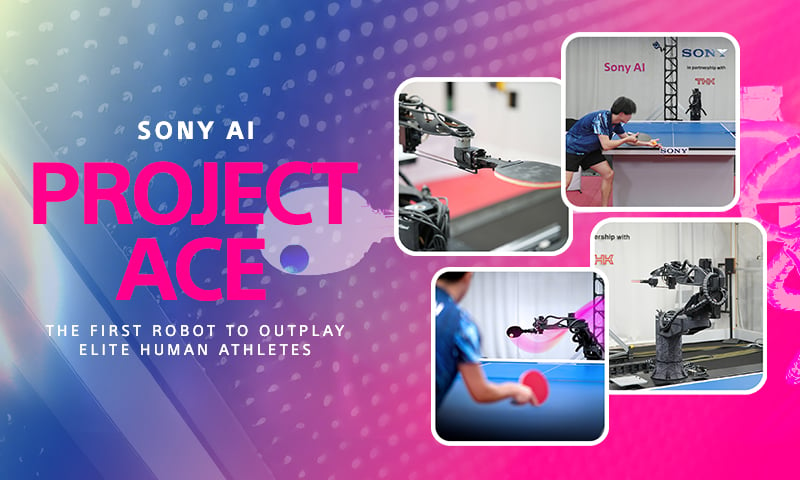
Sony AI just achieved something the robotics community has been chasing for decades. Their Project Ace robot is now the first autonomous system to defeat professional table tennis players in competitive matches, and the research earned a cover spot on Nature. This is not a controlled demonstration or a carefully staged showcase. The robot played real matches under International Table Tennis Federation regulations against players from Japan's professional T.League.
Why Table Tennis Matters for AI Research
Table tennis has long been considered the ultimate stress test for robotics and AI systems. The ball travels at velocities exceeding 20 meters per second with spin rates reaching 160 revolutions per second. Players must perceive, decide, and act within milliseconds. There is no time for deliberation. The margin for error is measured in centimeters.
Previous robotics achievements, such as DeepMind's AlphaGo defeating world champion Go players or OpenAI's bots mastering Dota 2, operated in purely digital domains. The physical world introduces complications that software cannot ignore: variable lighting, imperfect actuators, unpredictable opponent behavior, and the unforgiving physics of a small celluloid ball bouncing at high speed.
Project Ace solves these problems simultaneously. The system perceives the ball's position and spin in real time, predicts its trajectory, plans an optimal return stroke, and executes that plan through a robotic arm holding an actual paddle. All of this happens faster than a human can blink.
The Technical Architecture Behind Project Ace
The perception system represents perhaps the most impressive engineering achievement. Sony combined twelve high-speed sensors working in parallel. Nine IMX273 active pixel sensors operating at 200Hz track the ball's 3D position. Three IMX636 event-based vision sensors (developed with Prophesee) capture motion changes at sub-millisecond precision. Pan-tilt mirrors and telephoto tunable lenses measure angular velocity and spin.
The result is a perception latency of just 10.2 milliseconds. When the ball leaves an opponent's paddle, the robot already knows where it is going.
The control system uses deep reinforcement learning trained in physics-accurate simulation. Rather than programming explicit rules for every possible scenario, the team let the AI discover optimal strategies through millions of simulated rallies. A hierarchical architecture separates strategic shot selection from the low-level motor commands required to execute them. The robot operates at a 1kHz control frequency, meaning it adjusts its movement a thousand times per second.
The hardware itself features two prismatic and six revolute joints optimized for the specific movement patterns table tennis demands. The system can return balls traveling at up to 19.6 meters per second.
Match Results Against Human Professionals
Sony AI tested their robot against elite and professional players in multiple sessions throughout 2025 and 2026.
In April 2025, Ace played best-of-three games against five elite players, each with over a decade of competitive experience. It won three of five matches. The robot then faced two professional T.League players (Minami Ando and Kakeru Sone) in best-of-five games.
December 2025 matches against four new opponents, including two professionals, showed continued improvement. Ace defeated both elite players and one professional. By March 2026, in matches against three new professional players, Ace defeated all three at least once.
The statistics tell an interesting story. The robot achieved a return rate exceeding 75% even when handling extreme spins up to 450 radians per second. It scored 16 "ace" points against elite players compared to their collective 8. The December and March matches showed measurably "higher shot speeds, more aggressive placement closer to the table edge, and faster-paced rallies."
What This Means for Physical AI
This breakthrough matters far beyond sports entertainment. Table tennis served as a proving ground for technologies that will define the next generation of autonomous systems.
The perception system's ability to track and predict high-speed objects in variable conditions applies directly to autonomous vehicles, industrial automation, and surgical robotics. The reinforcement learning techniques that taught Ace to adapt mid-rally could enable robots to handle the unexpected situations that warehouse and manufacturing environments constantly present.
Peter Stone, Sony AI's Chief Scientist, emphasized that Ace demonstrates AI systems can "perceive, reason, and act effectively in complex, rapidly changing real-world environments." Peter Durr, Director of Sony AI Zurich, led the technical work that made this possible.
For those of us in the UAE and across the Middle East building AI systems, this research offers a roadmap. The combination of high-frequency sensing, physics-based simulation for training, and hierarchical decision-making represents a proven architecture for real-world AI applications.
Looking Forward
Sony AI's achievement marks a turning point. The gap between what AI can accomplish in simulations versus physical reality has been a persistent challenge in our field. Project Ace demonstrates that gap can be closed.
The techniques pioneered here will likely appear in commercial robotics within the next few years. When they do, the impact on manufacturing, logistics, healthcare, and countless other industries could be substantial. Sometimes the most important research does not come from the obvious places. A robot playing ping pong just taught us something fundamental about what autonomous systems can accomplish in the physical world.
Sources: