The AI infrastructure race just took an unexpected turn: to the open ocean. Oregon-based startup Panthalassa announced a $140 million Series B round led by Peter Thiel to build autonomous, wave-powered AI data centers that float at sea. This is not a research project or a concept video. The company plans to deploy its Ocean-3 pilot nodes in the northern Pacific this year, with commercial rollout beginning in 2027.
Why the Ocean? The Grid Cannot Keep Up
The core problem Panthalassa addresses is brutally simple: AI workloads are growing faster than terrestrial power infrastructure can scale. Data centers in the US face grid interconnection delays of 3 to 5 years. Even after permits clear, the competition for land, water rights, and local power capacity has become fierce. Hyperscalers are paying premiums for nuclear plants, stringing cables to geothermal sources, and lobbying for special treatment on electrical grids.
Panthalassa bypasses all of this by generating power at the point of compute. There is no grid interconnection. There is no land acquisition. There is no competition for municipal water supplies. The ocean provides both the energy source and the cooling medium.
As CEO Garth Sheldon-Coulson put it: "The ocean is really unlimited in terms of how much energy is available. It will really be the cheapest energy on the planet. Clean, no fuel, no land use, no getting in the way of other activities on land."
How the Technology Works
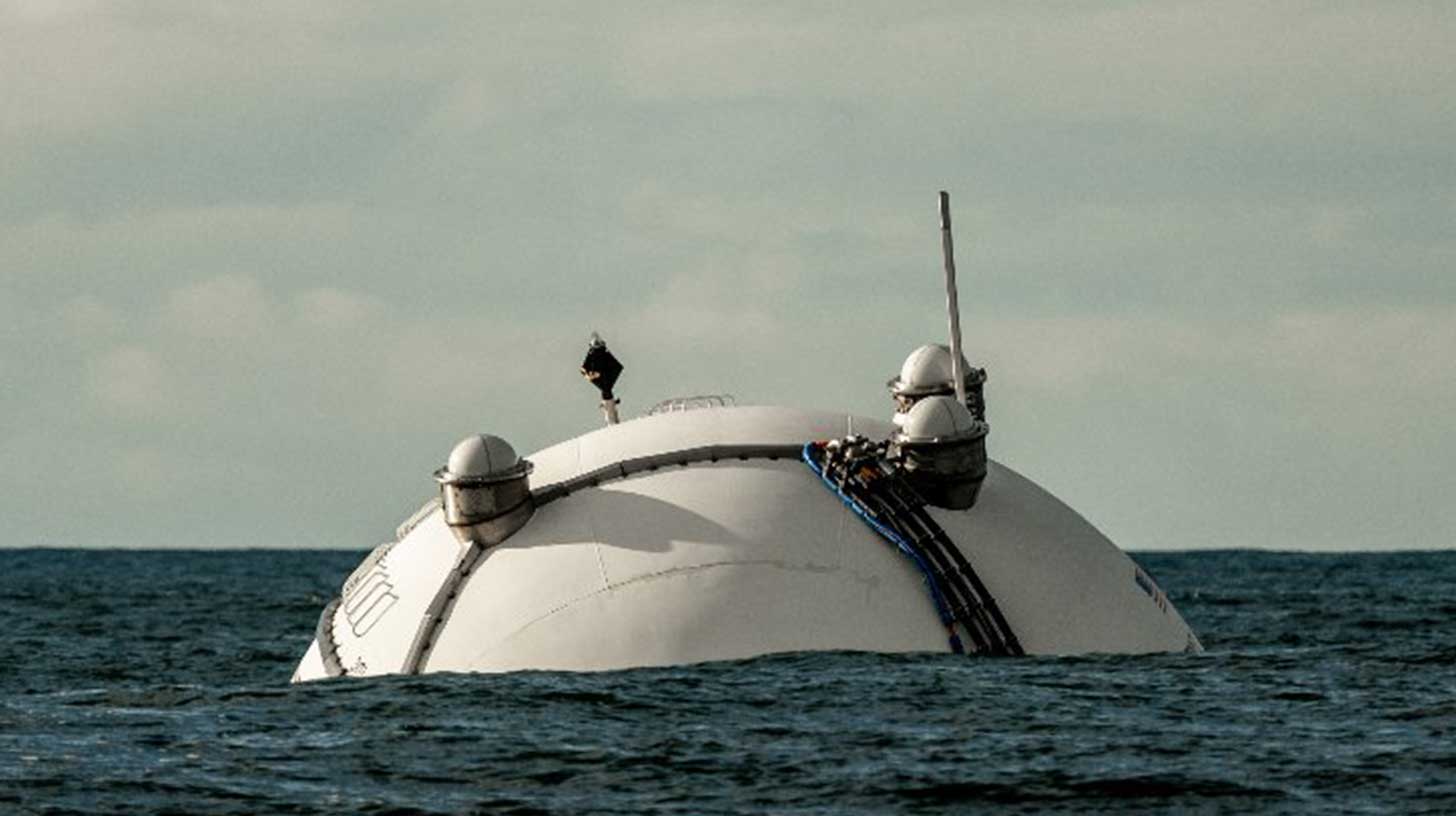
The Ocean-3 node looks something like an inverted lollipop: a spherical chamber roughly 50 meters in diameter sits atop a 60 to 70 meter neck that extends below the waterline. The entire system operates untethered, with no anchor cables connecting it to the ocean floor. Sheldon-Coulson describes it as "like a little Roomba, except it's enormous."
Wave motion causes water to flow through an internal tube and into the spherical chamber, where it passes through turbines to generate electricity. Earlier iterations (the Ocean-2 series) validated this approach with a simpler tethered design. The Ocean-3 advances to full autonomy: self-propelled, self-navigating, and self-powered.
The surrounding seawater provides direct cooling for onboard AI chips. Rather than transmitting power to shore, the nodes run inference workloads locally and send tokens back to customers via low-Earth-orbit satellite links. No cables. No grid dependencies. Just compute floating at sea.
The Numbers That Matter
One detail stands out in Panthalassa's pitch: their wave energy systems can deliver power up to 90% of the time. Compare that to offshore wind at 30-40% capacity factor, or onshore solar at roughly 25%. For AI inference workloads that need consistent availability, this reliability advantage matters.
The investor roster reinforces the ambition. Beyond Thiel as lead, the round includes John Doerr, Marc Benioff's TIME Ventures, Max Levchin's SciFi Ventures, Susquehanna Sustainable Investments, Hanwha Group, Fortescue Ventures, Super Micro Computer, and Dylan Field (founder of Figma). This is serious infrastructure capital, not speculative venture money.
As Thiel stated: "Extra-terrestrial solutions are no longer science fiction. Panthalassa has opened the ocean frontier."
What This Means for Enterprise AI
For organizations building AI applications, the infrastructure layer increasingly determines what is possible. Training large models requires concentrated compute and power at continental scale. Inference, by contrast, benefits from distribution, low latency, and cost optimization.
Floating AI data centers optimized for inference could serve several use cases:
- Edge inference for maritime applications: Shipping, offshore energy, naval operations, and oceanographic research could all benefit from compute located physically closer to the operation.
- Geographic redundancy: Ocean-based compute nodes add resilience against terrestrial grid failures, natural disasters, and geopolitical disruptions.
- Sustainability requirements: Organizations facing carbon commitments or ESG scrutiny could run inference on renewably-powered ocean nodes.
- Overflow capacity: When land-based data centers hit capacity, ocean nodes could absorb excess inference demand without multi-year construction timelines.
The satellite connectivity model also has interesting implications. For applications where latency tolerance exists (batch processing, background inference, non-real-time analytics), ocean compute becomes viable. Real-time applications requiring sub-10ms latency will still need terrestrial infrastructure.
Regional Implications for the Gulf
From a UAE and Middle East perspective, this development is worth watching closely. The Gulf region has abundant coastline, strong solar resources, and growing ambitions in AI infrastructure. If floating AI data centers prove viable in the Pacific, the technology could eventually expand to warmer waters where cooling efficiency differs and wave patterns vary.
More immediately, the Panthalassa model illustrates a broader trend: the willingness of major investors to fund unconventional infrastructure approaches when traditional scaling paths face bottlenecks. For regional AI strategies, this suggests keeping options open on infrastructure innovation rather than assuming current approaches will persist indefinitely.
Looking Ahead
Panthalassa's Ocean-3 pilot deployment later this year will be the real test. A decade of development has brought the company to this point. If the pilot demonstrates reliable power generation, stable compute operations, and viable satellite connectivity, expect rapid follow-on investment and potential competitors entering the space.
The AI infrastructure constraint is real. Data centers require power, cooling, and connectivity. Land-based approaches face increasing friction. Space-based solutions remain far-future. Ocean-based infrastructure sits in between: unconventional but physically grounded, ambitious but deployable within years rather than decades.
The companies that secure reliable, cost-effective compute infrastructure will have meaningful advantages in the AI deployment race. Panthalassa just made that competition considerably more interesting.