The idea of AI running a laboratory used to be science fiction. This week, OpenAI and Ginkgo Bioworks demonstrated it is now science fact. Their collaboration produced an autonomous laboratory system where GPT-5 designs experiments, sends them to robotic equipment, analyzes results, and iterates, all with minimal human intervention. Over six months, the system ran 36,000 protein synthesis experiments and achieved a 40% cost reduction compared to previous benchmarks.
How the Autonomous Lab Works
The architecture is elegantly simple in concept but sophisticated in execution. GPT-5 generates experimental designs as digital files specifying reaction compositions in 384-well plate format. Before any experiment runs, strict programmatic validation (using the Python library Pydantic) checks that the designs are both scientifically sound and physically executable on the robotic platform.
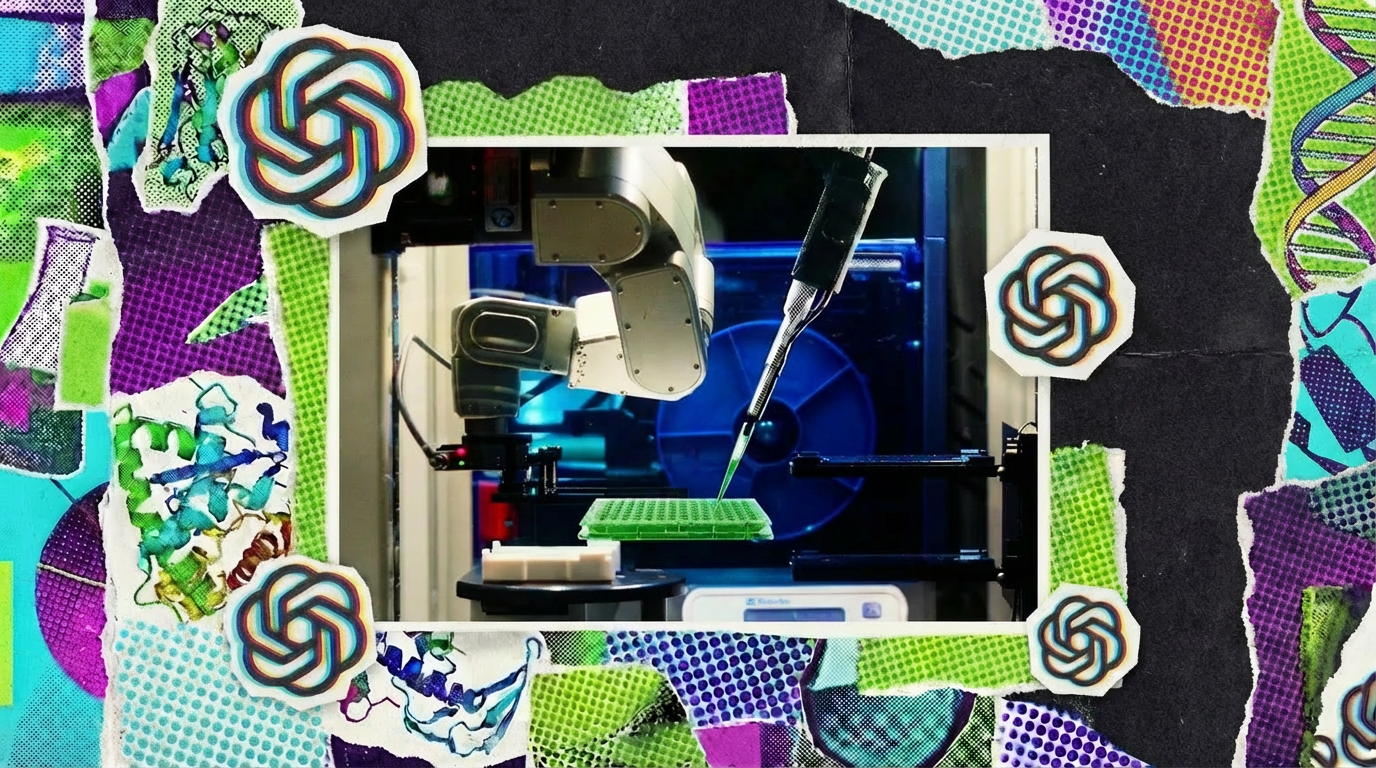
Once validated, the designs go to Ginkgo Bioworks' cloud laboratory in Boston. The lab uses modular robotic units called Reconfigurable Automation Carts (RACs), with each cart containing specialized equipment. Robotic arms and transport rails move sample plates between stations, while Ginkgo's Catalyst software orchestrates the workflow.
When experiments complete, measurement data flows back to GPT-5, which analyzes results, formulates hypotheses, and designs the next round. This closed-loop system removes the traditional bottleneck of human scientists manually interpreting data and planning follow-up experiments.
The Results Are Impressive
The benchmark target was cell-free protein synthesis (CFPS) of superfolder green fluorescent protein (sfGFP), a standard test protein in the field. Over six experimental rounds and 580 automated microtiter plates, GPT-5 explored over 36,000 reaction compositions.
The outcomes speak for themselves:
- Production cost dropped from $698 to $422 per gram (40% reduction)
- Reagent costs alone fell by 57%, from $60 to $26 per gram
- Protein yield increased by 27%
These improvements came not from a single breakthrough but from systematic optimization across multiple variables: buffer compositions, enzyme concentrations, energy sources, and reaction conditions. GPT-5 could explore this high-dimensional space far more efficiently than traditional experimental design methods.
Why This Matters for AI Practitioners
For those of us working in applied AI, this project demonstrates several important principles.
First, validation layers are essential. The team built strict programmatic checks to ensure AI-generated experiments were physically executable. Without this, GPT-5 might have proposed "paper experiments" that look plausible but cannot actually run in a robotic workflow. This pattern applies broadly: when deploying AI systems that generate actionable outputs, always validate against real-world constraints.
Second, closed-loop systems unlock compound improvement. Each experimental round informed the next. The AI was not simply running pre-programmed experiments; it was learning from results and adapting its strategy. This iterative refinement is where AI systems often outperform static approaches.
Third, specialization beats generalization for scientific tasks. GPT-5 was not used as a general chatbot here. It was integrated into a specific workflow with defined inputs, outputs, and constraints. This focused application yielded measurable results that a generic "ask the AI" approach would not.
Implications for the Middle East
The Gulf region is investing heavily in biotechnology and life sciences. The UAE's national biotech strategy, Saudi Arabia's NEOM biotech initiatives, and Qatar's research parks all aim to build world-class capabilities in this sector.
Autonomous laboratory systems could accelerate these ambitions significantly. Rather than competing for scarce human expertise, regional institutions could deploy AI-driven experimentation platforms that run continuously. A lab that operates 24/7 without fatigue, systematically exploring parameter spaces humans would find tedious, changes the economics of scientific discovery.
For AI teams in the region, this also highlights an opportunity: building the integration layers and validation frameworks that connect large language models to physical systems. The machine learning research is important, but so is the unglamorous work of making AI outputs safe and executable in real-world environments.
Limitations to Consider
The researchers were transparent about constraints. All results came from a single protein (sfGFP) and a single CFPS system. Whether the optimized reaction compositions transfer to other proteins remains unclear. The system also requires substantial upfront investment in robotic infrastructure and software integration.
This is not a turnkey solution that any lab can adopt tomorrow. It is a proof of concept showing what becomes possible when frontier AI models connect to automated experimental platforms.
Looking Forward
The OpenAI and Ginkgo Bioworks collaboration represents a new paradigm for scientific research. AI is no longer just analyzing data or generating hypotheses; it is actively running the experimental cycle. As these systems mature and generalize beyond single proteins, we may see fundamental changes in how biotechnology research operates.
For AI practitioners, the lesson is clear: the most impactful applications often come from deeply integrating AI into existing workflows, complete with validation, feedback loops, and domain-specific constraints. The autonomous lab is not just a GPT-5 demo; it is a blueprint for how AI can transform physical industries.