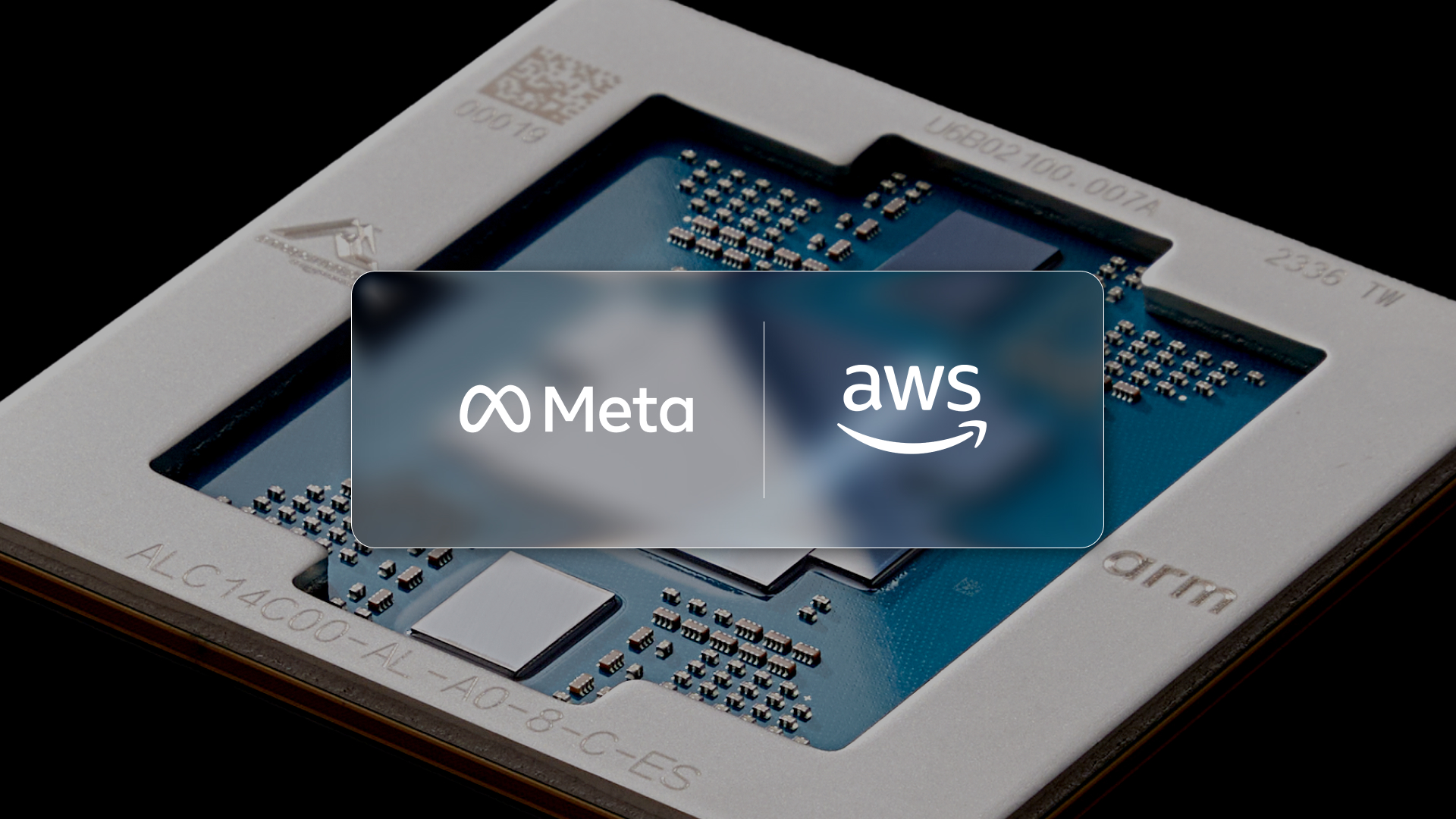
The shift from prompt-response AI to autonomous agents requires fundamentally different infrastructure. Meta just made that bet concrete, announcing a partnership with AWS to deploy tens of millions of Graviton cores specifically for agentic AI workloads.
Why Graviton for AI?
GPUs dominate AI training, but inference and orchestration tell a different story. Agentic AI systems do not simply generate responses: they reason, plan, execute multi-step tasks, and coordinate across services. These workloads are CPU-intensive and demand low latency across billions of concurrent interactions.
AWS Graviton5 processors, built on a 3-nanometer process, deliver 192 cores per chip with cache 5x larger than the previous generation. Core-to-core communication latency dropped 33%, and overall performance improved by 25% compared to Graviton4. For Meta's scale, these marginal gains compound into significant cost and efficiency advantages.
Santosh Janardhan, Meta's Head of Infrastructure, framed the decision clearly: "Diversifying our compute sources is a strategic imperative. AWS has been a trusted cloud partner for years, and expanding to Graviton allows us to run CPU-intensive workloads behind agentic AI with the performance and efficiency we need."
The Scale of This Deployment
Meta is now among the largest Graviton customers in the world. The initial deployment spans tens of millions of cores, with flexibility to expand as agentic workloads grow. This is not a pilot program or proof of concept: it represents a multi-year commitment to a specific architectural direction.
The partnership builds on Meta's existing use of Amazon Bedrock at scale. By adding Graviton to their compute portfolio alongside GPUs and TPUs, Meta gains the ability to route different workload types to purpose-built silicon rather than forcing everything through a single architecture.
Nafea Bshara, VP and Distinguished Engineer at Amazon, emphasized the infrastructure thesis: "This isn't just about chips; it's about giving customers the infrastructure foundation to build AI that understands, anticipates, and scales efficiently to billions."
What Agentic AI Actually Demands
The term "agentic AI" gets overused, but the technical requirements are concrete. Unlike stateless inference, agents maintain context across multiple interactions. They execute code, call external APIs, manage state, and make sequential decisions based on intermediate results.
Consider what happens when Meta AI helps a user plan a trip: the system searches for flights, checks hotel availability, compares prices, considers user preferences, and coordinates bookings across multiple services. Each step involves inference, but the orchestration layer requires sustained CPU resources for reasoning and coordination.
At Meta's scale, serving billions of users with these capabilities means running enormous CPU fleets. Graviton's performance-per-watt advantage becomes critical when you are operating at data center scale. The economics of agentic AI favor architectures that can sustain long-running, context-heavy workloads efficiently.
Implications for Enterprise AI Strategy
This partnership signals where infrastructure priorities are heading. Organizations building agentic capabilities should consider several factors:
Workload segmentation matters. Training, inference, and orchestration have different computational profiles. Treating all AI workloads identically leads to suboptimal resource allocation and inflated costs.
CPU performance is undervalued. The industry focus on GPU scarcity obscures the reality that agentic workloads need substantial CPU resources. Planning capacity for both is essential.
Cloud partnerships are deepening. Meta, despite having massive internal infrastructure, is expanding its reliance on AWS for specialized workloads. The build-versus-buy calculus continues shifting toward hybrid approaches even for hyperscalers.
For the UAE and Middle East region, where several nations are investing heavily in AI infrastructure, this partnership offers a template. Sovereign AI initiatives should consider how to support both training (GPU-intensive) and deployment (CPU-intensive) workloads as agentic capabilities become standard.
The Competitive Dynamics
This deal also reflects competitive positioning. Meta using AWS Graviton chips, rather than building proprietary silicon or relying solely on x86 alternatives, validates ARM-based architectures for production AI workloads at scale. It pressures other cloud providers to demonstrate similar capabilities.
The timing matters too. As AI moves from research demos to production systems serving billions, the companies that solve infrastructure economics gain lasting advantages. Meta's willingness to deploy tens of millions of cores from a competitor's cloud division suggests the technology and pricing are compelling enough to outweigh strategic concerns.
What Comes Next
The initial deployment focuses on CPU-intensive agentic workloads, but the partnership includes flexibility for expansion. As Graviton continues improving and agentic AI adoption accelerates, expect this relationship to deepen.
For practitioners and organizations evaluating their AI infrastructure strategies, the lesson is clear: agentic AI demands infrastructure rethinking. The systems that will power the next generation of AI applications look different from those that enabled the chatbot era. Meta's bet on Graviton reflects that reality.
The future of AI infrastructure is not just about training the largest models. It is about deploying intelligent agents that can reason and act autonomously at scale. That requires purpose-built silicon, hybrid cloud architectures, and partnerships that optimize for specific workload characteristics rather than one-size-fits-all solutions.