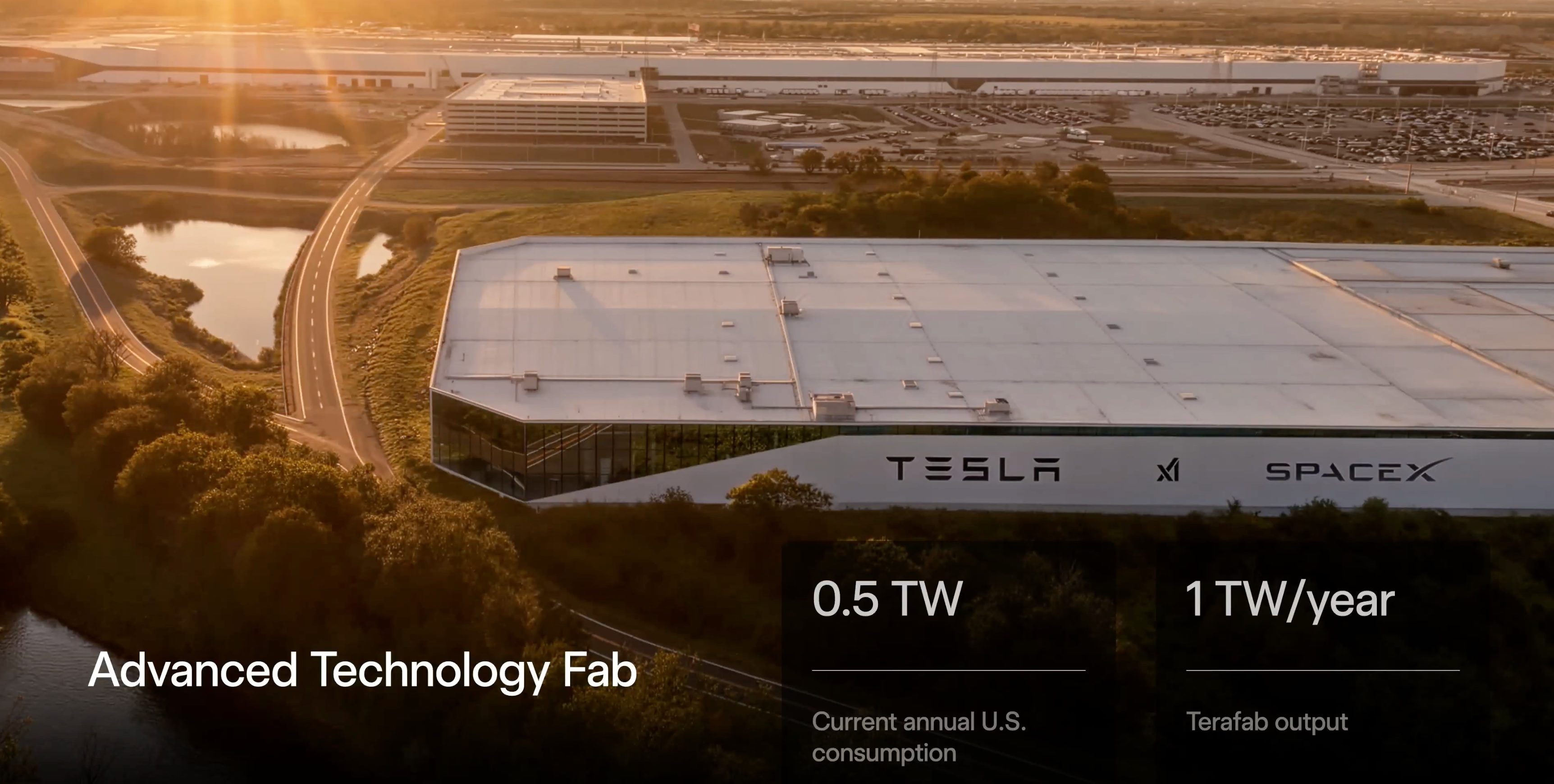
The semiconductor industry just witnessed one of its most significant strategic moves in years. Intel announced on April 7 that it will join Elon Musk's Terafab project, partnering with Tesla, SpaceX, and xAI to construct a massive AI chip manufacturing facility in Austin, Texas. This $25 billion initiative aims to produce 1 terawatt of compute power annually, potentially reshaping the AI hardware landscape.
What Makes Terafab Different
Musk announced Terafab on March 21, 2026, with an ambitious vision: consolidate every stage of semiconductor production under one roof. This includes chip design, lithography, fabrication, memory production, advanced packaging, and testing. The goal is to eliminate the fragmented supply chain that currently spans multiple countries and companies.
The project targets 2-nanometer process technology with an initial capacity of 100,000 wafer starts per month. Tesla's fifth-generation AI chip, the AI5, will be among the first products manufactured at the pilot facility, with small-batch production anticipated in late 2026 and volume production in 2027.
Intel brings something Musk's companies lack: decades of manufacturing expertise. As Intel stated in their announcement, "Our ability to design, fabricate, and package ultra-high-performance chips at scale will help accelerate Terafab's aim to produce 1 TW/year of compute."
The Strategic Logic for Both Parties
For Intel, this partnership offers a path back to relevance in the AI chip race. The company has struggled to compete with NVIDIA's dominance in AI accelerators and TSMC's manufacturing leadership. Terafab positions Intel as the manufacturing backbone for one of the world's most ambitious AI infrastructure projects.
For Musk's ecosystem, Intel solves a critical bottleneck. Tesla, xAI, and SpaceX all face escalating demand for custom silicon. Tesla needs chips for its Optimus humanoid robots and Full Self-Driving systems. xAI requires massive compute for training models like Grok. SpaceX plans to deploy orbital AI servers that need specialized processors.
The reality, as several analysts have noted, is that Tesla will not actually build and operate its own fab. Intel will handle the manufacturing operations while Tesla serves as the anchor customer. This makes strategic sense: building semiconductor fabs requires expertise that takes decades to develop.
Why This Matters for AI Infrastructure
The AI industry faces a fundamental hardware constraint. NVIDIA dominates the market for training chips, while TSMC manufactures the vast majority of advanced processors. This concentration creates supply chain vulnerabilities and geopolitical risks that every AI company must navigate.
Terafab represents an attempt to build an alternative path. By combining Musk's capital and demand with Intel's manufacturing capabilities, the project could diversify the AI chip supply chain. The facility will use Intel's 18A process node, which promises competitive performance with TSMC's most advanced offerings.
The 1 terawatt annual compute target is staggering. To put this in perspective, that is roughly equivalent to the total AI compute capacity that existed globally just a few years ago. If Terafab achieves its production goals, it could meaningfully expand the world's AI training and inference capacity.
Implications for the Middle East
From my perspective in the UAE, this development carries important implications for our region's AI ambitions. Gulf nations are investing heavily in AI infrastructure, including partnerships with hyperscalers and plans for sovereign AI capabilities.
The Terafab model demonstrates a new approach: vertical integration of the AI hardware stack. Rather than depending entirely on existing chip manufacturers, large organizations are beginning to build dedicated production capacity. Saudi Arabia's partnership with NVIDIA and the UAE's investment in AI data centers follow similar logic.
However, semiconductor manufacturing at this scale requires specialized talent, supply chains, and water resources that few locations can provide. The Middle East's AI strategy will likely continue focusing on inference and deployment infrastructure rather than chip fabrication. What Terafab does offer is potential diversification of chip supply, reducing the risk of supply chain disruptions that could affect regional AI projects.
The Road Ahead
Intel's stock rose more than 3% on the announcement, signaling market optimism about the partnership. But significant challenges remain. Building a state-of-the-art fab takes years, and achieving the targeted production volumes will require flawless execution.
The competitive dynamics are also uncertain. TSMC and Samsung are not standing still. NVIDIA continues to advance its chip designs. And the geopolitical landscape around semiconductors grows more complex by the month.
What Terafab does represent is a serious commitment to expanding domestic AI chip production in the United States. Whether it succeeds or stumbles, the project signals that the AI infrastructure race is entering a new phase: one where control over manufacturing capacity matters as much as algorithmic breakthroughs.
For AI practitioners and business leaders, the lesson is clear. The companies building tomorrow's AI systems are increasingly thinking about hardware supply chains as strategic assets. As AI becomes infrastructure, controlling that infrastructure becomes a competitive advantage.