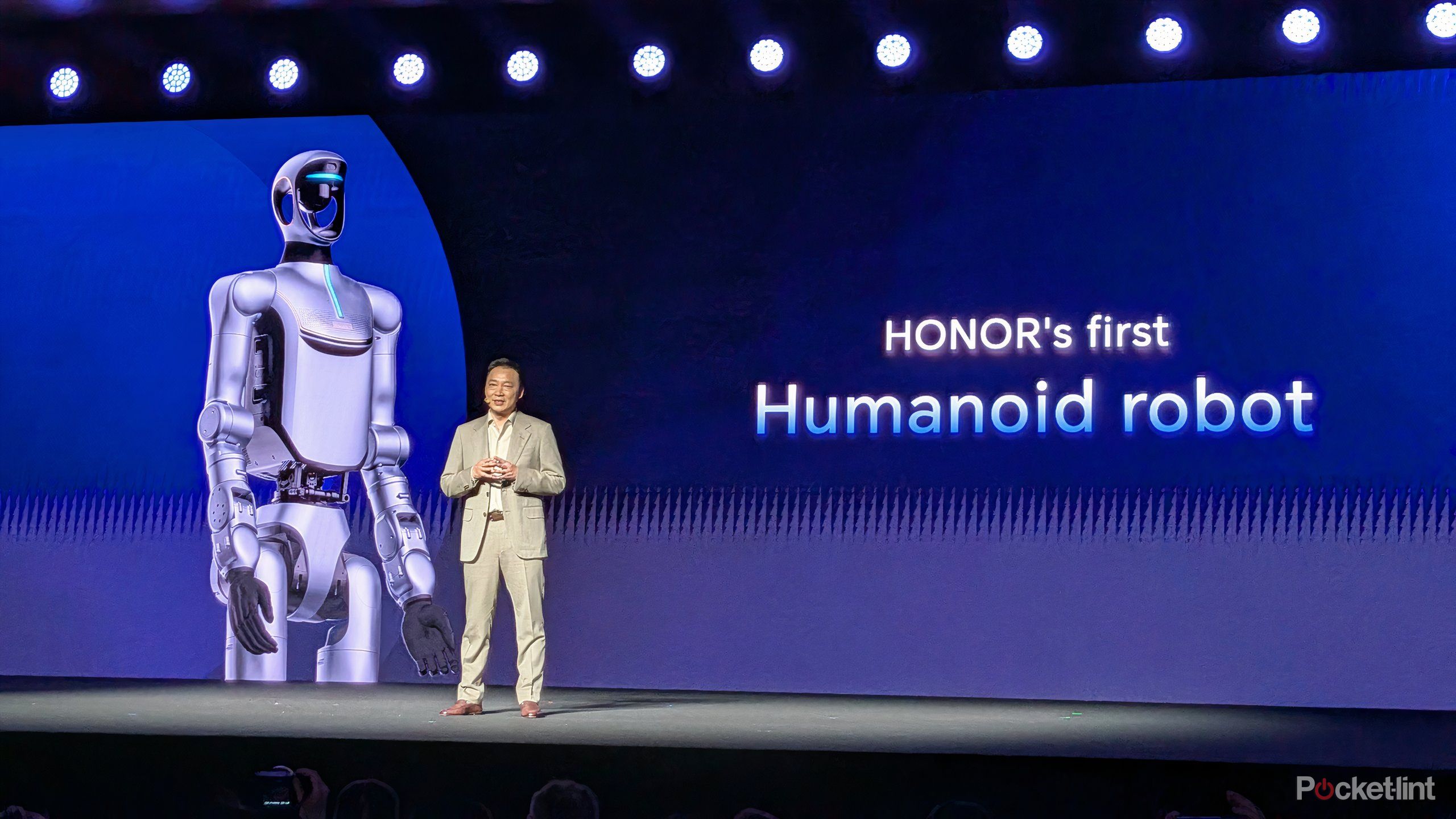
Honor just did something no smartphone manufacturer has done before. At Mobile World Congress 2026 in Barcelona, the company unveiled its first humanoid robot alongside a concept device called the Robot Phone. This is not a side project or a flashy demo. It is the centerpiece of a $10 billion, five-year investment plan that aims to transform Honor from a smartphone company into an AI-powered device ecosystem.
The Humanoid Robot: Speed and Design
The Honor humanoid robot makes an immediate impression. It runs at 4 meters per second, which translates to about 14.4 kilometers per hour. That is 14% faster than Boston Dynamics' Atlas, making it one of the fastest bipedal robots demonstrated to date. The design is a matte-black frame with blue LED accents, giving it an aesthetic that feels more consumer-friendly than industrial.
Under the hood, Honor uses a bionic joint design paired with dynamic balance algorithms. The company developed this in partnership with Unitree, the Chinese robotics firm that has been making waves with its affordable humanoid platforms. This collaboration suggests Honor is serious about bringing robotics expertise in-house rather than building everything from scratch.
The target applications are practical: retail assistance, home services, and companionship. Based on the specifications and Honor's partnerships, analysts estimate the robot could launch at a price point between $15,000 and $35,000. That would position it competitively against the Unitree G1 at $13,500 and the 1X NEO at around $20,000.
The Alpha Plan: A $10 Billion Bet on AI Hardware
The humanoid robot is part of what Honor calls the "Alpha Plan," a strategic initiative to pivot from pure smartphone manufacturing to building an entire AI device ecosystem. The $10 billion investment over five years covers not just robotics but also what Honor describes as "embodied AI" across multiple device categories.
This matters because it signals how smartphone manufacturers view the next decade. Apple is doubling down on spatial computing with Vision Pro. Samsung is integrating agentic AI into Galaxy devices. Xiaomi and Vivo are also quietly building robotics divisions. Honor's explicit, heavily funded move into humanoid robotics is the most aggressive pivot we have seen from a mobile OEM.
For AI practitioners, this creates new opportunities. Companies like Honor will need talent that understands both mobile AI (on-device inference, power efficiency, real-time processing) and robotics AI (spatial reasoning, manipulation, navigation). The skill sets are converging, and the hiring will follow.
The Robot Phone: Where Smartphones Meet Robotics
Honor also unveiled the Robot Phone, a concept that blurs the line between smartphone and robotic device. The standout feature is a pop-out camera module with gimbal stabilization and subject tracking. This is not software stabilization. It is mechanical, robot-grade motion control built into a phone form factor.
The 200MP sensor can track subjects autonomously during video calls and recording. It moves physically, following the user or subject without manual input. Honor describes this as bringing "embodied intelligence to the consumer level," and while the marketing language is bold, the engineering is genuinely novel.
The Robot Phone is scheduled for commercial release in the second half of 2026, moving from concept to product in under a year. If Honor delivers on this timeline, it will be the first smartphone with integrated robotic actuation shipping at scale.
What This Means for the Robotics Market
Honor entering the humanoid space matters for several reasons. First, it validates the market. When a company with Honor's resources and manufacturing scale makes a $10 billion bet on robotics, it signals that the sector is approaching commercial viability. Second, it accelerates competition. China already dominates humanoid robot shipments (13,000 units in 2025, most from Chinese manufacturers), and Honor adds another well-funded player to the mix.
Third, and perhaps most importantly for those of us working in AI, it expands the application space. Honor is not targeting factories or warehouses. It is targeting homes and retail environments. Consumer-facing humanoid robots require different AI capabilities than industrial ones: natural language understanding, social awareness, aesthetic design, and seamless integration with smartphones and smart home devices.
This opens research and development opportunities in human-robot interaction, embodied language models, and consumer-grade safety systems. If you are working on these problems, the potential customers and deployment partners just multiplied.
Looking Ahead
Honor's MWC 2026 announcements represent a turning point for consumer robotics. A major smartphone manufacturer is now fully committed to humanoid robots, backed by billions in investment and a clear strategic roadmap. The technology is still nascent, but the intent is unmistakable.
For the UAE and Middle East region, this is worth watching closely. The Gulf states have been investing heavily in robotics and AI infrastructure, from Saudi Arabia's NEOM plans to the UAE's national AI strategy. Companies like Honor will be looking for regional partners, pilot deployments, and markets willing to adopt humanoid robots at scale. The organizations that position themselves now, whether as technology partners, enterprise customers, or research collaborators, will have first-mover advantages as this market matures.
The humanoid robot era is not coming. Based on what we saw at MWC 2026, it has arrived.