Fujitsu just announced something that should make every software development leader pay attention. Their new AI-Driven Software Development Platform claims to automate the entire software development lifecycle, from requirements gathering to integration testing, with a staggering 100x productivity improvement in real-world deployments.
What Fujitsu Actually Built
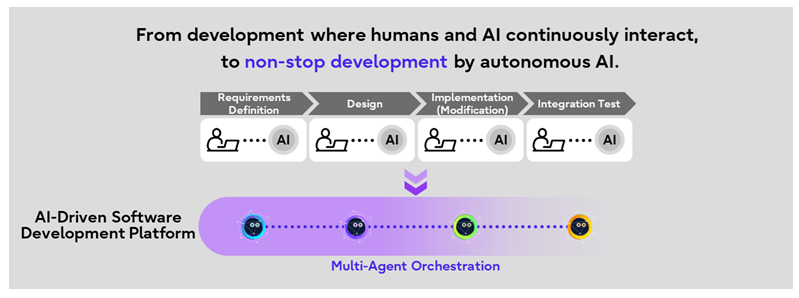
The platform leverages Fujitsu's Takane large language model combined with agentic AI technology specifically designed for large-scale software development. Rather than using a single AI assistant, the system orchestrates multiple AI agents that collaboratively execute each stage of development.
Here is what makes this approach different from typical AI coding assistants:
- Full lifecycle coverage: The platform handles requirements definition, system design, implementation, and integration testing
- Multi-agent collaboration: Different AI agents specialize in different development stages, working together autonomously
- Enterprise system comprehension: The agents can understand complex, evolving large-scale systems owned by enterprises and public organizations
- Self-auditing quality control: AI agents audit quality and autonomously repeat processes to ensure reliability
This is not just code completion or suggestion. Fujitsu claims the platform can execute entire development workflows without human intervention.
The 100x Productivity Claim: Real Numbers
The headline number comes from a real deployment, not a benchmark. Starting in January 2026, Fujitsu has been using the platform in Japan for software modifications required by the 2026 medical fee revisions.
The results: modifications that would have taken three person-months using conventional methods were completed in four hours.
That is a 100-fold increase in productivity on actual production software. Not a toy demo. Not a greenfield prototype. Real modifications to existing enterprise software in a regulated industry.
Why This Matters for Enterprise Software
If you work in enterprise software development, you know the pain points: legacy systems with decades of accumulated complexity, regulatory changes requiring rapid modifications across multiple interconnected systems, and chronic shortages of developers who understand both the business domain and the technical architecture.
Fujitsu's platform targets exactly these scenarios. The "AI-Ready Engineering" approach they describe involves preparing existing enterprise assets and knowledge so AI can accurately comprehend systems and achieve reliable automation.
This is the critical insight. The challenge in enterprise AI automation is not building smarter models. It is making existing systems legible to AI. Fujitsu appears to have invested heavily in this translation layer.
Expansion Plans and Industry Impact
Fujitsu plans to apply the platform to all 67 of their medical and government software products by the end of fiscal year 2026. They will also expand to finance, manufacturing, retail, and public services sectors.
For organizations in the UAE and Middle East, this development signals several important trends:
Accelerated digital transformation: Government and healthcare sectors often struggle with the pace of system modernization. Platforms like this could dramatically compress timelines for regulatory compliance updates and system migrations.
Shifting workforce requirements: The role of software developers will increasingly shift toward architecture, oversight, and quality assurance rather than implementation. Organizations should start planning for this transition now.
Enterprise AI maturity: This represents a leap beyond copilot-style assistants toward fully autonomous development agents. The AI infrastructure investments many organizations are making today will enable these capabilities.
Questions That Remain
Several important questions remain unanswered in Fujitsu's announcement:
- How does the platform handle edge cases and novel requirements that were not part of its training?
- What level of human oversight is actually required in practice versus theory?
- How does it perform on systems built with diverse technology stacks versus Fujitsu's own standardized platforms?
- What is the licensing and deployment model for organizations outside Japan?
The 100x productivity claim, while impressive, was measured on a specific type of modification (regulatory compliance updates) on systems that Fujitsu already understands deeply. Results will vary significantly across different contexts.
Looking Ahead
Fujitsu's AI-Driven Software Development Platform represents the next phase of AI in software engineering. We are moving beyond AI as a coding assistant toward AI as a development workforce.
For technology leaders, the question is no longer whether to adopt AI development tools, but how to prepare your organization's systems, processes, and teams for a future where AI agents handle increasingly complex development tasks autonomously. The organizations that invest in making their systems "AI-ready" today will be best positioned to leverage these capabilities as they mature.