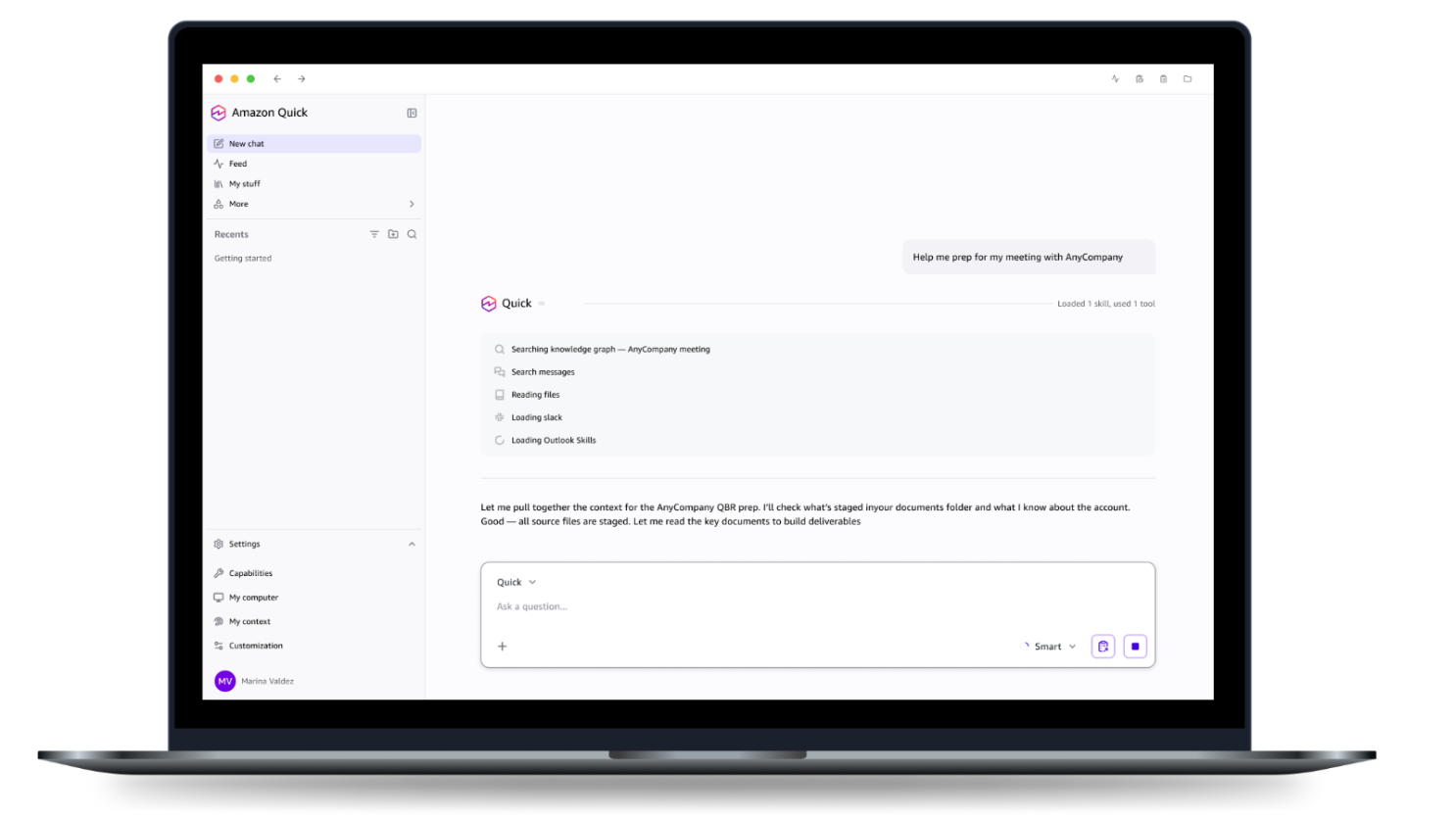
AWS has launched Amazon Quick as a native desktop application for macOS and Windows, and it represents a meaningful shift in how enterprise AI assistants should work. Rather than being another chatbot you visit when you have a question, Quick runs continuously in the background, monitoring your work context and building what AWS calls a "personal knowledge graph" that compounds over time.
Why This Matters for Enterprise AI
Most AI assistants today are stateless. You open ChatGPT, Claude, or Copilot, give it context about your task, get an answer, and then repeat the context dance in your next session. This friction is why many knowledge workers find AI tools useful but not transformative: the overhead of explaining your situation often outweighs the benefit of the response.
Amazon Quick takes a different approach. By running as a persistent desktop application with access to your local files, calendar, and communications, it can build genuine context about your work. It learns your projects, your people, and your patterns. When you sit down Monday morning, Quick already knows what meetings you have, which deadlines are approaching, and which email threads need your attention.
This is the vision many of us in the AI practitioner community have been waiting for: AI that remembers, anticipates, and acts rather than just responds.
How Amazon Quick Actually Works
The architecture is straightforward but powerful. Quick connects to your existing enterprise tools, including Google Workspace, Microsoft 365, Salesforce, Slack, Teams, Zoom, ServiceNow, Asana, and Jira. It indexes your local files and monitors your desktop activity without requiring you to upload documents to some cloud service.
From this continuous observation, Quick builds a personal knowledge graph. This graph captures:
- People and relationships: Who you work with, reporting structures, project team memberships
- Project context: What you are working on, dependencies, timelines, stakeholders
- Communication patterns: How you typically respond, your writing style, your preferences
- Historical decisions: Past context that might be relevant to current work
The result is an assistant that can proactively surface meeting-relevant notes before you join a call, draft email replies based on your previous conversations (not generic templates), and catch scheduling conflicts before they become problems.
Practical Capabilities Worth Noting
Beyond the contextual intelligence, Quick includes several practical features that caught my attention:
Content creation without context switching: You can generate presentations, dashboards, and documents directly within Quick using natural language. Amazon Books reportedly reduced document preparation time by 80% using this capability. The key difference from standalone AI tools is that Quick already knows your brand guidelines, previous presentations, and data sources.
Browser automation: Quick can automate browser-based workflows, which opens up integration possibilities with web applications that do not have official API connectors. This is particularly valuable for enterprise workflows that involve legacy systems.
Developer tool integration: For technical teams, Quick connects with developer environments, making it potentially useful for code-related tasks that benefit from organizational context.
Enterprise Adoption Signals
The customer list AWS highlighted includes 3M, GoDaddy, BMW, Mondelez, NFL, and Southwest Airlines. These are large organizations with complex technology stacks and serious security requirements. Their participation suggests AWS has addressed the enterprise governance concerns that often block AI adoption.
For organizations in the UAE and Middle East, where we often work with global enterprises and government entities that have strict data sovereignty requirements, the desktop-first approach is interesting. Unlike cloud-only assistants, Quick can work with local files without requiring them to leave your device. Of course, the specific data handling and residency details would need to be verified for each deployment scenario.
Where This Fits in the AI Assistant Landscape
Amazon Quick enters a market that already includes Microsoft Copilot, Google's Gemini for Workspace, and various startup solutions. The differentiation seems to be the persistent knowledge graph approach and the desktop-native architecture.
Microsoft Copilot is deeply integrated with Microsoft 365 but requires living within that ecosystem. Google Gemini has similar constraints around Google Workspace. Quick appears designed to work across these boundaries, connecting multiple enterprise platforms into a unified context.
For organizations with heterogeneous tool environments (which describes most large enterprises I work with), this cross-platform approach could be the deciding factor.
Practical Considerations
Quick is currently in preview, which means production deployments should wait for general availability. The pricing model is not yet public, though it will likely follow AWS's typical per-user-per-month structure similar to Amazon Q Business.
For AI practitioners evaluating this space, I would recommend:
- Assess your tool fragmentation: Quick's value proposition is strongest when you have multiple disconnected productivity platforms.
- Consider the security model: Understand exactly what data Quick accesses, where it stores the knowledge graph, and what controls exist.
- Start with contained pilots: Choose a team with representative workflows but manageable scale for initial evaluation.
Looking Forward
The release of Amazon Quick at AWS's What's Next event, alongside expanded Amazon Connect agentic AI solutions and the AWS-OpenAI partnership expansion, signals AWS's serious commitment to enterprise AI beyond infrastructure. They are now competing in the application layer, directly against Microsoft and Google.
For those of us building enterprise AI strategies, this competition benefits everyone. The more pressure these vendors face to deliver genuinely useful AI assistants (rather than impressive demos that fail in practice), the faster we will see tools that actually transform knowledge work.
Whether Amazon Quick specifically becomes the dominant enterprise AI assistant is less important than whether it pushes the entire category toward the persistent, contextual, proactive model that knowledge workers actually need.