
NVIDIA has just announced something that could reshape how universities and research labs approach humanoid robotics. At GTC Taipei, the company unveiled the NVIDIA Isaac GR00T Reference Humanoid Robot, an open-source design that combines commercial hardware with NVIDIA's physical AI software stack. For those of us working in applied AI, this represents a significant shift: frontier robotics research is becoming more accessible.
What Makes This Reference Design Different
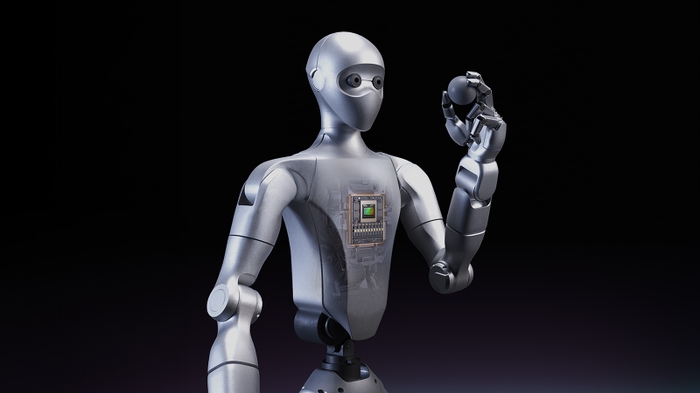
The Isaac GR00T Reference Humanoid Robot is not a product you can buy off the shelf for deployment. Instead, it is a complete blueprint for research institutions to build capable humanoid robots without starting from scratch. The design combines the Unitree H2 Plus chassis with Sharpa Wave five-fingered hands and NVIDIA's Jetson AGX Thor T5000 compute module.
The specifications are impressive: 75 degrees of freedom (including 22 in each hand for dexterous manipulation), 128GB of unified memory, and up to 2,070 FP4 teraflops from the integrated Blackwell GPU. The robot stands nearly six feet tall and weighs 150 pounds, with approximately three hours of battery life on a single charge.
What matters more than raw specs is the integration. The reference design works seamlessly with NVIDIA's Isaac GR00T software ecosystem, which includes teleoperation tools for data capture, foundation models for multimodal reasoning, and simulation environments for training.
Why Open-Source Matters for Physical AI
Jensen Huang framed the opportunity clearly: "Humanoid robots will bring physical AI to the world's largest industries, opening a multitrillion-dollar economic opportunity." But realizing that opportunity requires dramatically lowering the barrier to entry for research.
Currently, most robotics labs either build custom platforms from the ground up (expensive and time-consuming) or adapt industrial robots that were not designed for human-like tasks. The Isaac GR00T Reference Humanoid Robot provides a middle path: a standardized, well-documented platform that can be replicated and extended.
Four leading research institutions have already signed on as early adopters: the Allen Institute for AI (Ai2), ETH Zurich's Robotic Systems Lab, Stanford Robotics Center, and UC San Diego's Advanced Robotics and Controls Laboratory. This consortium approach means improvements will be shared across the research community.
The Technical Stack Worth Understanding
The real innovation here is not the hardware alone but how it integrates with NVIDIA's software tools:
- Isaac Teleop enables researchers to capture manipulation data by piloting the robot remotely, essential for building training datasets
- GR00T foundation models take multimodal input (language and vision) to perform manipulation tasks without task-specific programming
- Isaac Sim and Isaac Lab provide digital twin environments where researchers can train policies in simulation before deploying on physical hardware
- Isaac ROS handles the middleware layer, connecting perception, planning, and control
The GR00T N1.7 model, trained on over 20,000 hours of human egocentric video, represents the current state of the art in Vision-Language-Action architectures. It can interpret natural language instructions and translate them into robot actions, a capability that was purely theoretical five years ago.
Implications for the UAE and Middle East
For AI practitioners and researchers in our region, this announcement has concrete implications. The UAE has been investing heavily in robotics and automation, particularly for logistics, healthcare, and construction. An open reference design from NVIDIA lowers the cost of entry for regional universities to conduct world-class humanoid robotics research.
I expect we will see Gulf universities partnering with international institutions to deploy these platforms locally. The combination of accessible hardware, pre-trained models, and comprehensive simulation tools means a well-funded research lab can now focus on novel applications rather than reinventing basic capabilities.
The three-hour battery life and configurable 40-130 watt power range also matter for deployment in our climate, where energy efficiency and heat management are constant concerns.
What Comes Next
The reference design will be available through Unitree in late 2026, with the reference workflow for the smaller Unitree G1 robots expected on GitHub and Hugging Face soon. This phased rollout gives the research community time to prepare.
Physical AI is where the next wave of transformative applications will emerge. We have spent the past few years proving that language models can reason about text. Now we are proving they can reason about the physical world and act on it. The Isaac GR00T Reference Humanoid Robot is infrastructure for that future, and the decision to open-source it will accelerate progress across the entire field.
For those of us building AI systems, this is a reminder that the most impactful contributions often come from enabling others, not from gatekeeping capabilities behind proprietary walls.