
NVIDIA has released Cosmos 3, the first fully open "omnimodel" for physical AI. Unlike traditional AI models that specialize in either understanding or generation, Cosmos 3 does both: it reasons about the physical world and generates realistic simulations of how that world might evolve. For anyone building robots, autonomous vehicles, or industrial vision systems, this is a significant development.
What Makes Cosmos 3 Different
The key innovation is architectural. Cosmos 3 uses what NVIDIA calls a mixture-of-transformers design, pairing a reasoning transformer with a generation transformer. The reasoning block interprets what is happening in a scene (object interactions, motion patterns, spatial relationships), while the generation block uses that context to produce physically grounded outputs.
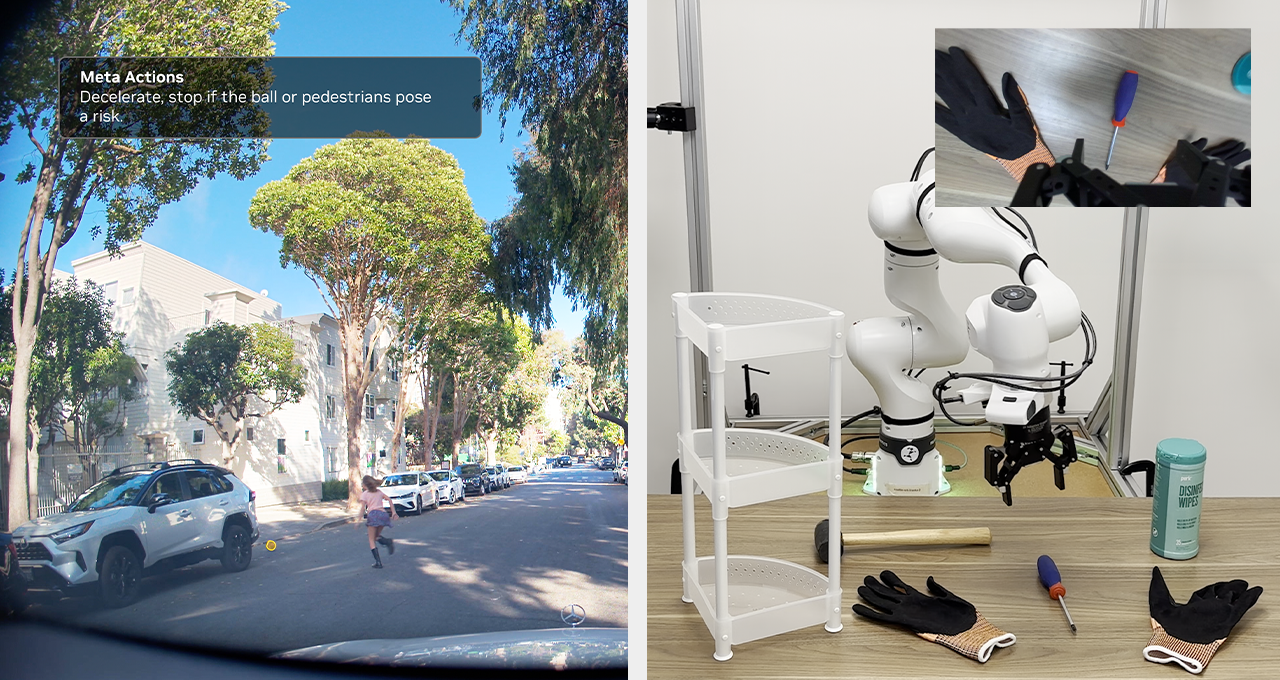
This matters because physical AI systems need both capabilities. A warehouse robot must understand where objects are and predict where they will be. An autonomous vehicle must reason about traffic patterns and anticipate pedestrian movements. Previous approaches required stitching together separate models for perception, planning, and simulation. Cosmos 3 integrates these into a unified architecture.
The model can natively understand and generate text, images, video, ambient sound, and actions. That last capability, action generation, is particularly relevant for robotics. Cosmos 3 can directly output joint angles, gripper positions, and trajectory points, making it usable as a foundation for robot policy development.
The Cosmos Model Family
NVIDIA has released three variants to address different deployment scenarios:
Cosmos 3 Super targets maximum physics accuracy. This is the flagship model for training and post-training workflows where quality matters more than latency. Research labs and robotics companies developing new capabilities would typically use this variant.
Cosmos 3 Nano focuses on speed, delivering high-quality reasoning in fractional seconds. This suits production systems that need real-time inference but can tolerate some accuracy trade-offs.
Cosmos 3 Edge (coming soon) is designed for real-time inference on edge devices. Robots and autonomous vehicles cannot always rely on cloud connectivity, so running capable models locally is essential for reliable operation.
All models are available under the OpenMDW 1.1 license from the Linux Foundation, which permits training, modification, redistribution, and deployment. This is genuinely open access, not the restricted licenses that have become common with frontier models.
Performance and Benchmarks
NVIDIA reports leading results across several benchmarks relevant to physical AI. Cosmos 3 achieves top scores on VANTAGE-Bench for smart infrastructure applications, testing capabilities like scene reasoning and traffic analysis. It also leads on Physics-IQ, R-Bench, and PAI-Bench, which measure physical reasoning and action generation.
The post-trained Cosmos 3 Nano policy leads performance on RoboLab, a simulation testing environment for robotics. This suggests the model architecture translates well from general physical reasoning to specific robot control tasks.
Jensen Huang, NVIDIA's CEO, described the release as giving developers "a generational leap in ability to build robots, autonomous vehicles and vision AI." The claim is ambitious, but the open availability means anyone can verify it against their own use cases.
The Cosmos Coalition
NVIDIA launched the Cosmos Coalition alongside the model release, a group of AI labs and robotics companies committed to advancing open world models. Founding members include Agile Robots, Black Forest Labs, Generalist, LTX, Runway, and Skild AI.
Additional companies building on Cosmos 3 span multiple industries. Robotics applications are being developed by Doosan Robotics, LG Electronics, and Samsung. Li Auto is working on autonomous vehicle simulation. Vision AI deployments are underway at Centific, Fogsphere, Linker Vision, Milestone Systems, and Yuan.
The breadth of partners suggests NVIDIA is positioning Cosmos 3 as infrastructure rather than a product. By building an ecosystem around open models, they can drive adoption of their hardware and NIM microservices while accelerating the broader physical AI market.
Practical Applications
The immediate applications fall into three categories.
Robotics policy development is perhaps the most transformative. Training robots in the real world is slow, expensive, and dangerous. Cosmos 3 enables training in simulation with physics-accurate environments, then transferring learned policies to physical robots. The model can generate synthetic training data for rare scenarios that would be difficult to collect otherwise.
Autonomous vehicle simulation benefits from similar dynamics. Testing edge cases (unusual pedestrian behavior, rare weather conditions, sensor failures) is impractical on public roads. World models like Cosmos 3 can generate these scenarios synthetically, accelerating validation cycles.
Industrial vision AI represents a third application area. Factory safety monitoring, quality inspection, and defect detection all require understanding physical scenes. Cosmos 3's reasoning capabilities can interpret complex industrial environments, while its generation capabilities can augment training data for specialized detectors.
Implications for the Region
For AI practitioners in the UAE and Middle East, Cosmos 3's open availability is noteworthy. Physical AI development has historically required either massive compute budgets for training custom models or licensing agreements with major AI labs. Neither option was accessible to most organizations in our region.
The open source release changes that calculation. Research institutions, startups, and industrial companies can now experiment with frontier physical AI capabilities without prohibitive costs. The model weights are available on Hugging Face and GitHub, and NVIDIA provides deployment through their NIM microservices.
Saudi Arabia and the UAE have significant investments in robotics and autonomous systems planned for projects like NEOM and smart city initiatives. Having open access to world-class foundation models reduces dependency on external providers and enables local customization.
What Comes Next
The release of Cosmos 3 accelerates a trend that has been building: physical AI moving from research demonstrations to production deployments. Foundation models are doing for robotics what they did for language, providing capable starting points that dramatically reduce the barrier to building useful systems.
I expect we will see increased activity in robotics applications over the next year. The combination of capable open models, available simulation tools, and maturing hardware platforms makes this a favorable time for development. The companies that figure out how to leverage foundation models for specific industrial applications will have significant advantages.
For those of us working in AI, the message is clear: physical AI is becoming practical, and the tools to build it are now accessible. The question is what we will build with them.